Best Red Light Therapy Panels 2026: A Buyer's Guide
Table of Contents
- What Separates Professional Red Light Therapy Panels From Gadgets
- Red Light Therapy Irradiance vs Power Density: What the Specs Really Mean
- Red Light Therapy Benefits for Recovery: What the Research Supports
- How Long to Use Red Light Therapy Panels for Best Results
- Full-Body vs Targeted Panels: Matching the Device to Your Space
- Long-Term Ownership: Maintenance, Repairability, and Support
- Frequently Asked Questions
Last Updated: September 15, 2026
What Separates Professional Red Light Therapy Panels From Gadgets
The gap between a clinical-grade device and a cheap gadget comes down to three measurable specs: irradiance, wavelength accuracy, and build quality. Professional red light therapy panels deliver verified optical output at therapeutic wavelengths, while budget units often list impressive wattage that never reaches your skin.
This guide from Sport Gains covers what the specifications actually mean, how to match a device to your recovery goals, and which trade-offs matter for long-term ownership. The core argument is simple: most buyers shop by wattage when they should be shopping by delivered dose.
FDA guidance on light-emitting products classifies these devices by their intended use, which is why some units are marketed for general wellness and others as cleared medical devices. That distinction shapes what claims a manufacturer can legally make.
Irradiance, Wavelength, and Build Quality
Irradiance is the amount of light power that actually lands on a surface, measured in milliwatts per square centimeter (mW/cm²). Two panels with identical wattage ratings can differ dramatically in irradiance because of LED quality, lens design, and beam angle.
Wavelength determines how deep the light penetrates tissue. Red light in the 630-670 nanometer range targets surface-level skin, while near-infrared light in the 810-850 nanometer range reaches deeper muscle and joint tissue. A quality panel states its peak wavelengths, not just a range.
Build quality shows up in heat dissipation. Aluminum heat sinks and active cooling keep output stable during longer sessions. Plastic housings on cheap units cause thermal drift, so the last ten minutes of your session deliver less light than the first.
Red Light Therapy Irradiance vs Power Density: What the Specs Really Mean
The two terms are often used interchangeably, but they describe different things. Irradiance measures light intensity at a specific distance from the panel. Power density describes the total energy delivered per unit area over time, expressed in joules per square centimeter (J/cm²).
Manufacturers who quote "1000W" are usually describing electrical draw, not optical output. A common mistake is assuming that number reflects what reaches your body. In practice, a well-built 300W panel with tight beam control can outperform a poorly designed 1000W unit.
To compare fairly, ask for three numbers:
- Irradiance at a stated distance (e.g., 100 mW/cm² at 15 cm)
- Peak wavelength with tolerance (e.g., 660nm ±5nm)
- Recommended session duration to reach a target dose
Why Flicker Rate and EMF Emissions Matter
Flicker-free operation is not a marketing buzzword. Cheap drivers pulse LEDs at low frequencies, which some users find causes eye strain or headaches during longer sessions. Quality panels use constant-current drivers that eliminate perceptible flicker.
EMF emissions at close range are another spec worth checking. A well-shielded panel keeps electromagnetic output low, which matters if you plan to stand within a few centimeters of the device for twenty minutes at a time.
Red Light Therapy Benefits for Recovery: What the Research Supports
The strongest evidence for recovery applications centers on reduced inflammation and faster muscle repair after strenuous exercise. Photobiomodulation, the technical term for how light interacts with cells, is thought to support mitochondrial function, which may help tissue recover more efficiently.
Many athletes and clinicians report meaningful improvements in soreness and joint discomfort when sessions are consistent.
How Long to Use Red Light Therapy Panels for Best Results
Session length is not a fixed number.
The Dose Equation You Should Actually Use
Dose (J/cm²) = Irradiance (mW/cm²) × Time (seconds) ÷ 1,000
Two examples make the math concrete:
- A panel rated at 50 mW/cm² at 15 cm, used for 10 minutes (600 seconds), delivers roughly 30 J/cm².
- A panel rated at 100 mW/cm² at 15 cm, used for the same 10 minutes, delivers roughly 60 J/cm².
A Practical Starting Framework
- Week 1-2: 10 minutes per session, every other day, at the distance the manufacturer specifies for its irradiance rating
- Week 3-4: 15 minutes, three to four times per week, if you tolerated the first two weeks with no irritation
- Ongoing: hold the dose steady for four to six weeks before changing anything, so you can actually attribute a result to a variable
Distance Changes Everything
Irradiance falls off sharply as you move away from the panel.
When to Split a Session
Track your sessions in a simple log. Most people who abandon home recovery equipment do so because they never established a routine, not because the device failed.
Full-Body vs Targeted Panels: Matching the Device to Your Space
This is the section most buying guides skip, and it is the one that determines whether your panel gets used or becomes an expensive closet ornament.
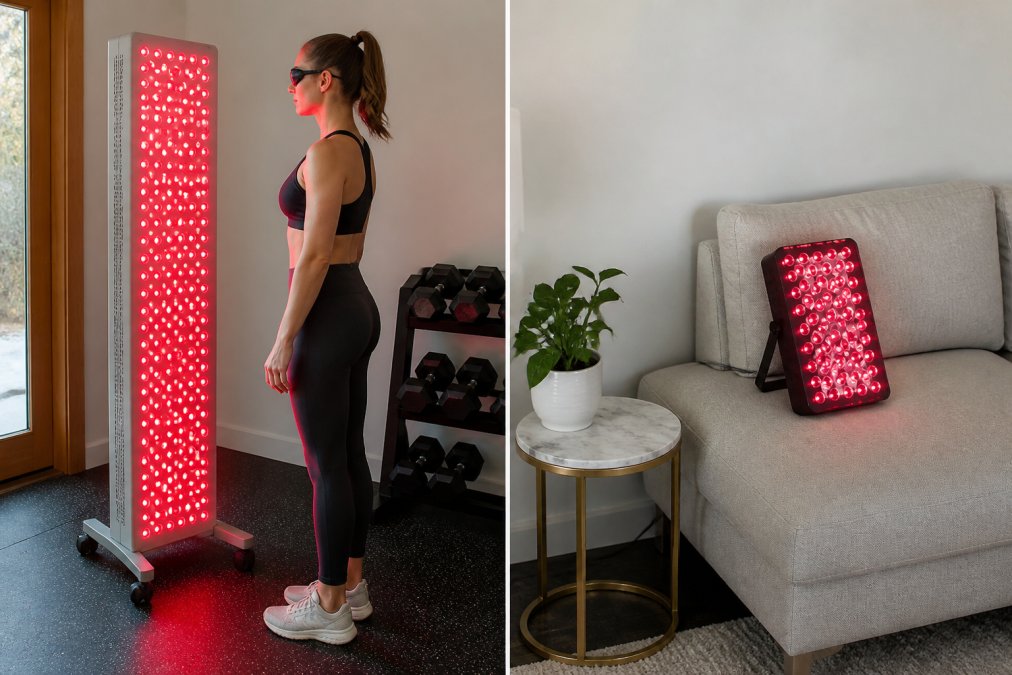
Start With a Floor Plan, Not a Spec Sheet
- Standing clearance. A full-body panel needs you to stand roughly 6 to 12 inches (15 to 30 cm) from the surface to hit its rated irradiance. Add your body depth and you need about 2 to 3 feet of clear floor in front of the panel.
- Wall or door width. Full-body panels commonly run 24 to 36 inches wide and 60 to 72 inches tall. A standard interior door is about 30 to 32 inches wide and 80 inches tall, which is why door-frame mounts are popular, but the panel plus mount hardware can exceed the opening.
- Ceiling height and outlet placement. A 72-inch panel on a stand puts the top of the unit near eye level for many adults. Check that your outlet is not directly behind where the panel will sit, or you will need a low-profile right-angle plug.
Mounting Options and What Each One Actually Costs You
- Door-frame mount. Uses the door casing as structure, no drilling into walls.
The Small-Apartment Playbook
- The closet-door swap. Mount a half-height panel on the inside of a closet door. Open the door to use it, close it to hide it. You lose the closet for storage while the panel is mounted.
- The hallway slot. A narrow freestanding panel in a hallway uses dead space that no furniture can occupy. Measure the hallway width first, you need the panel footprint plus your standing distance.
- The bed-adjacent targeted panel. A small panel on a nightstand or clamp mount aimed at a shoulder, knee, or lower back. This is the highest-adherence option for people who will not stand in one spot for 15 minutes.
When Targeted Beats Full-Body
- You are treating one specific area, like a knee, shoulder, or lower back.
- You have less than 3 feet of clear floor in front of a wall.
- You travel and want to bring the device with you.
- You are not confident you will use it daily. A panel that stores in a closet and sets up in 30 seconds gets used; a 6-foot panel that requires rearranging furniture does not.
Long-Term Ownership: Maintenance, Repairability, and Support
| Ownership Factor | What to Check | Why It Matters |
|---|---|---|
| LED lifespan | Rated hours at full output | Determines replacement timing |
| Driver type | Constant-current, flicker-free | Affects comfort and output stability |
| Warranty | Coverage of LEDs and driver | Signals build confidence |
| Parts availability | Replaceable components | Extends usable life |
| Support | Real human response times | Resolves issues without replacement |
Frequently Asked Questions
What is the best brand of red light therapy panels?
There is no single best brand for everyone. The right red light therapy panel depends on your treatment goals, available space, and budget. Look for devices with published irradiance data, flicker-free drivers, and a warranty that covers the LEDs. Sport Gains sources panels through authorized channels and offers a 30-day return policy so you can test one at home before committing.
What is the best red light therapy panel for full body treatment at home?
A full-body panel should be tall enough to cover most of your body in one session, typically at least 5 feet. Check the irradiance at your standing distance, the beam angle, and whether the panel includes mounting hardware. If you have limited floor space, a foldable or wall-mounted option works well. Sport Gains carries panels designed for daily home use with solid construction and accessible pricing.
How do I pick a good red light panel?
Start with wavelength: 630-660 nanometers for surface-level skin benefits and 810-850 nanometers for deeper muscle and joint recovery. Then check irradiance, which tells you how much light energy reaches your body per second. Flicker-free operation and low EMF emissions matter for daily use. Finally, look at build quality and customer support. A panel with strong specs but poor heat dissipation will not last.
Are red light therapy panels worth the investment in 2026?
If you use one consistently, a home panel costs less over time than repeated clinic sessions. The key is consistency: most protocols call for 10 to 20 minutes per session, several times per week. A durable panel built for daily use, like those from Sport Gains, makes that routine easier to maintain. If you are unsure, the 30-day return policy lets you test the habit before fully committing.
Choosing the right panel comes down to matching verified output, wavelength, and build quality to your actual routine and space. Sport Gains curates red light therapy panels and recovery equipment built for daily use, sourced through authorized channels and backed by a 30-day return policy. See how it works and build a home recovery setup that lasts.