Red Light Therapy for Knee Pain: A How-To Guide
Table of Contents
- How Red Light Therapy Works for Knee Pain Relief
- Red Light Therapy Treatment Duration for Knees
- How to Use Red Light Therapy Devices at Home
- Near-Infrared vs. Red Light Wavelengths for Joint Pain
- Safety, Side Effects, and Contraindications
- Integration with Physical Therapy and Long-Term Maintenance
- Troubleshooting Non-Responsive Cases and Recovery Protocols
- Frequently Asked Questions
Last Updated: September 23, 2026
How Red Light Therapy Works for Knee Pain Relief
Red light therapy knee pain relief uses specific wavelengths to stimulate cellular activity in damaged or inflamed joint tissue. When red and near-infrared light penetrate the skin, they reach the mitochondria and trigger photobiomodulation, boosting energy production to reduce inflammation and support tissue repair.
Light energy stimulates cytochrome c oxidase in mitochondrial cells, driving ATP production. More ATP means your cells have energy to heal damaged cartilage, reduce swelling, and repair connective tissue. For knee pain, this matters because osteoarthritis drains cellular energy, red light therapy restores that energy, resulting in less pain and better mobility.
Wavelengths matter: red light (630-660 nanometers) penetrates shallow tissue, while near-infrared light (810-850 nanometers) reaches deeper joint structures. Professional-grade devices combine both to treat the full depth of knee tissue.

Red Light Therapy Treatment Duration for Knees
The ideal treatment duration is 10-20 minutes per session, 3-5 times per week. Most people see measurable improvement in joint stiffness and pain within 2-4 weeks of consistent use.
Duration depends on your device's power output and condition. A high-output panel like the Sport Gains ULTRA1500 may deliver effective treatment in 10-15 minutes. Start with 10-minute sessions and increase to 15-20 minutes if tolerated well.

For chronic osteoarthritis, expect 8-12 weeks for significant cartilage and mobility improvements, though pain reduction often occurs within 2-3 weeks.
Consistency beats intensity. A 15-minute session five times per week outperforms a 45-minute session once weekly.
How to Use Red Light Therapy Devices at Home
Pre-Treatment Preparation
Choose a quiet location where you can sit undisturbed. Clean the treatment area with a soft cloth. Remove any knee braces, compression sleeves, or clothing covering the joint, these block near-infrared wavelengths and reduce effectiveness by 40-60%.
Wait 20-30 minutes after exercise before treating.
Setup and Positioning
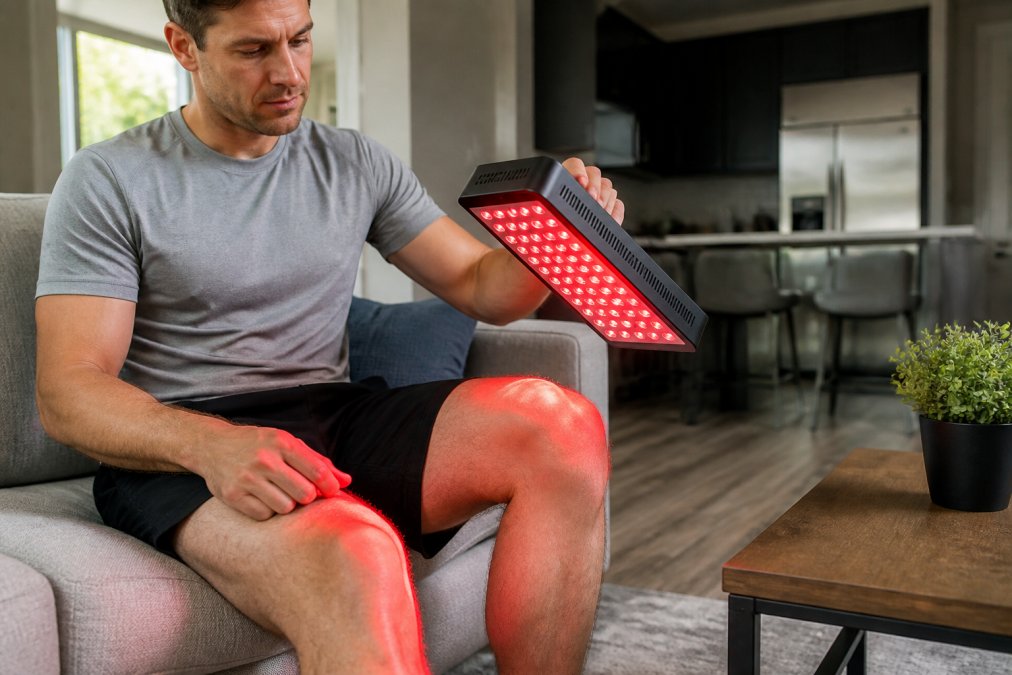
Position your device 6-12 inches from the skin over your knee. Higher-output devices work effectively at 8-12 inches; lower-output panels perform better at 4-6 inches.
Expose your knee skin-to-light. Sit comfortably with your leg extended or slightly bent. Aim the panel at the center of your knee joint, or slightly lower if pain is in the patellar tendon.
Use a stand to hold your panel steady; moving it reduces energy density and creates uneven exposure.
Session Protocol and Frequency
Turn on the device at 50% intensity if new to red light therapy. Higher intensity doesn't accelerate results and increases inflammation risk.
Run your session for 10-15 minutes with a timer. Perform treatment 3-5 times per week, skipping one day between sessions when possible.
Track results in a log noting date, duration, brightness level, pain (1-10 scale), and stiffness. After 4 weeks, patterns will show what works for your condition.
Post-Treatment Recovery Protocol (Critical for Results)
Immediately after your session (first 30 minutes), keep your knee relaxed. Avoid standing, walking, or weight-bearing activity. Sit or lie down with your leg elevated.
During the 30-120 minute window post-treatment, perform gentle mobility work: slow knee flexion and extension 10-15 times, quadriceps stretches for 20-30 seconds, and slow walking for 5-10 minutes.
Avoid high-impact activity for at least 2-3 hours post-treatment. No running, jumping, heavy lifting, or intense exercise. If you must exercise on a treatment day, do it before your session, not after.
Monitor for delayed swelling 4-6 hours after treatment, especially in the first 2-3 weeks, this is a healing response. If swelling occurs, apply ice for 10 minutes and elevate your leg. It typically resolves within 12-24 hours. If it persists beyond 24 hours, reduce your next session to 10 minutes and lower brightness to 30%.
Tracking Adherence and Adjusting Protocol
Consistency matters more than intensity. If you miss more than 2 consecutive sessions, restart your protocol.
After 4 weeks, assess your progress: 20-30% pain reduction and improved morning stiffness? If yes, continue. If no, move to troubleshooting before assuming therapy isn't working.
Near-Infrared vs. Red Light Wavelengths for Joint Pain
Red light (630-660 nanometers) penetrates 2-3 millimeters for surface inflammation. Near-infrared light (810-850 nanometers) penetrates 8-10 millimeters deep, reaching cartilage and synovial fluid.
For red light therapy knee pain management, you need both wavelengths: surface inflammation responds to red light, while deep cartilage damage responds to near-infrared.
Professional devices combine both wavelengths. The Sport Gains ULTRA1500 includes 630nm, 660nm, 810nm, and 850nm outputs, treating your entire knee joint from surface to depth.
If you're managing osteoarthritis specifically, prioritize near-infrared output. That wavelength range addresses the cartilage and synovial inflammation that drives most knee pain in older adults.
Safety, Side Effects, and Contraindications
Red light therapy for knee pain relief is non-invasive with minimal risk when using professional-grade equipment and proper protocols.
Common mild side effects include temporary joint soreness 24-48 hours after initial sessions (a healing response) or temporary swelling in the first 1-2 weeks. If swelling becomes painful or persists beyond 2 weeks, reduce frequency to 2 times per week and duration to 10 minutes.
Red Light Therapy Panel Designed for →
Avoid red light therapy if you have active cancer or suspicious skin lesions in the treatment area, take photosensitizing medications, have a fever or acute infection in your knee, or are pregnant and treating the abdomen (though knee treatment is safe).
If you take any prescription medications, check with your doctor before starting.
Integration with Physical Therapy and Long-Term Maintenance
Red light therapy works best with physical therapy exercises. The light reduces inflammation and stimulates repair; physical therapy rebuilds strength and mobility.
Perform red light therapy, then do 10-15 minutes of light stretching or resistance exercises. Start with knee extensions, quadriceps stretches, and walking. Add lunges or step-ups as pain decreases.
This combination accelerates improvement significantly, producing faster pain relief and better long-term mobility.
For long-term maintenance, most people need 1-2 sessions per week after the initial 8-12 week treatment phase. Schedule maintenance sessions on a consistent day. Many people treat on Monday and Thursday, or Tuesday and Friday.
Troubleshooting Non-Responsive Cases and Recovery Protocols
Diagnostic Framework: Why Red Light Therapy Isn't Working
Some people don't see improvement after 4-6 weeks. This usually means one of five specific factors needs adjustment.
Factor 1: Device Output Verification
Verify your device actually delivers the power it claims. Professional-grade panels like the Sport Gains ULTRA1500 have published specifications: 300 quad-chip LEDs, 4 wavelengths (630nm, 660nm, 810nm, 850nm), and measurable irradiance. Budget devices often deliver 30-50% less light than advertised.
If you're using an older or low-cost device, upgrade to a professional panel with verified wavelengths and LED specifications. If you already own a professional device, check that all LEDs are functioning by looking at the panel in a dark room, all LEDs should glow evenly.
Factor 2: Treatment Protocol Compliance
Verify your positioning and consistency. Distance matters exponentially. A device 18 inches away delivers one-quarter the energy of the same device at 9 inches. Measure your distance with a ruler and maintain it consistently using a stand or mounting system.
Inconsistent sessions also delay results. If you're missing days or skipping weeks, your tissue never gets the sustained stimulus needed for repair. Track your sessions in a calendar. After 4 weeks, you should have completed 12-20 sessions.
Brightness level matters too. If you've been running sessions at maximum brightness, reduce to 50-70% and extend duration to 15-20 minutes instead.
Factor 3: Underlying Biomechanical Issues
If your knee pain stems from biomechanical issues (misalignment, weak glutes, poor posture, or gait abnormalities), red light therapy alone won't fix it.
Factor 4: Severity of Cartilage Damage
Factor 5: Medication and Metabolic Interference
Escalation Protocol for Non-Responsive Cases
If you've verified all five factors above and still see no improvement after 6 weeks, follow this escalation sequence.
Weeks 6-8: Increase Near-Infrared Exposure
Weeks 8-10: Combine with Professional Physical Therapy
Week 10+: Reassess with Your Doctor
Recovery Optimization for Responders
If you are seeing improvement, optimize your recovery protocol to accelerate results.
Frequently Asked Questions
How long should I use red light therapy on my knees?
Most clinical protocols recommend 10-20 minute sessions, 3-5 times per week for knee pain relief. Start with 10 minutes at 6-12 inches from the knee joint. Consistency matters more than duration, daily 15-minute sessions often outperform sporadic longer sessions. Track your pain levels weekly to adjust frequency. If inflammation is severe, begin with shorter sessions and gradually increase as tolerance builds.
Does red light therapy actually help knee pain?
Red light therapy reduces knee pain by stimulating mitochondrial function and reducing joint inflammation through photobiomodulation. Studies show it improves joint mobility and decreases stiffness in osteoarthritis and rheumatoid arthritis patients. Results typically appear within 2-4 weeks of consistent use. The effect is most pronounced when combined with physical therapy or mobility work rather than used alone.
Can you overdo red light therapy on your knee?
Overuse is rare but possible, excessive sessions may cause temporary warmth or mild discomfort without lasting harm. Stick to recommended dosages: 10-20 minutes per session, 3-5 times weekly. If you experience skin irritation or increased swelling after treatment, reduce session duration by 5 minutes and extend the interval between sessions. Most users tolerate daily short sessions better than infrequent long ones.
What wavelengths work best for knee pain, red or near-infrared light?
Both work synergistically. Red light (630-660nm) penetrates superficial tissue and reduces inflammation at the surface. Near-infrared light (810-850nm) penetrates deeper into joint cartilage and bone. Panels offering multiple wavelengths (like the ULTRA360 or ULTRA1500) deliver balanced coverage, use both simultaneously for optimal results on chronic knee pain, especially osteoarthritis affecting deep joint structures.