


Home Recovery Equipment Daily Use: A Practical Guide
Table of Contents
- Why Home Recovery Equipment Daily Use Matters
- Building Your Home Recovery Equipment Checklist
- Creating a Daily Recovery Routine at Home
- Red Light Therapy Panel for Home: Setup and Usage
- Cold Plunge at Home: Frequency, Duration, and Safety
- Safety, Contraindications, and When to Stop
- Maintenance, Cleaning, and Equipment Longevity
- Tracking Progress and Knowing Your Routine Is Working
- Frequently Asked Questions
Last Updated: October 12, 2026
Why Home Recovery Equipment Daily Use Matters
Building a sustainable recovery practice at home transforms how your body bounces back from training, stress, and daily wear.
The difference between occasional recovery and daily recovery is profound. A study on recovery protocols from the American College of Sports Medicine shows that consistent, frequent recovery interventions outperform sporadic intensive sessions.
At Sport Gains, our approach rests on one principle: the best recovery tool is the one you'll use every single day.

This guide covers building a realistic home recovery setup, a daily routine that sticks, and which tools matter most for your goals. Whether you're managing chronic inflammation, optimizing athletic performance, or sleeping better, the foundation is consistent, intentional recovery.
Building Your Home Recovery Equipment Checklist
Your recovery setup doesn't need to be expensive or complicated, just intentional. Start with the essentials, add what serves your goals, and upgrade strategically as your practice deepens.
Think of your toolkit in three tiers, so you build gradually without wasting money on premium gear before you know what you'll actually use.
Tier 1: Essential Tools for Beginners
Start here. These tools address the most common recovery needs and work for nearly everyone.
Foam rollers target muscle tension and improve blood flow.
Massage balls (lacrosse balls work fine) reach smaller muscle groups your foam roller misses: feet, glutes, shoulders.
Resistance bands serve double duty: mobility and strength activation.
Stretching costs nothing and remains non-negotiable. A 10-minute daily routine beats expensive equipment you don't use. Focus on tight areas: hip flexors, hamstrings, chest, shoulders.
Heat packs (microwaveable or electric) support relaxation and reduce muscle tension, especially during evening wind-down. Apply 15-20 minutes before bed.
This tier covers roughly 70% of recovery needs for most people. Total investment: $50-100.
Tier 2: Intermediate Recovery Systems
Once you've built a consistent practice, these tools accelerate results and target specific goals.
Massage guns deliver percussion therapy, improving blood flow and reducing soreness. They're particularly useful post-workout, with sessions of 1-2 minutes per muscle group.
Cold therapy (cold plunges or ice baths) triggers systemic recovery responses. The Sport Gains Cold Plunge System ($3,089) features iceless cooling, so you don't need constant ice restocking.
Red light therapy panels support cellular recovery and reduce inflammation. The [Sport Gains Red Light Therapy Panel](https://sportgains.com/products/red-light-therapy-panel-device-630nm-660nm-810nm-850nm-red-near-infrared-light-therapy-led-light-therapy-lamp-72-quad-chip-leds-adjustable-brightness-pulse-mode-ultra360) ($1,019) uses 72 quad-chip LEDs across four wavelengths (630nm, 660nm, 810nm, 850nm).

Compression (boots or bands) enhances circulation and reduces swelling. Sessions run 20-30 minutes; quality systems cost $400-800.
This tier is where benefits compound: cold plunge + red light therapy + stretching produces results none achieve alone.
Tier 3: Premium Long-Term Investments
These tools represent significant investment but deliver measurable long-term value for serious practitioners.
Infrared saunas support detoxification, cardiovascular health, and deep relaxation. The Sport Gains 3-Person FAR Infrared Sauna ($5,189) uses solid Canadian cedar and carbon heating panels, with 30-45 minute sessions 2-3 times per week.
Massage chairs provide full-body recovery and relaxation. The Sport Gains Massage Chair 4D ($2,720.72) features a 55-inch SL-track, zero-gravity positioning, and 20 automatic programs. Sessions run 20-30 minutes and pair well with evening wind-down.

Vibration plates improve balance, strength, and circulation. Quality units run $1,500-3,000.
This tier makes sense once you've committed to daily practice and identified which modalities deliver the most value for your goals.
| Tier | Key Tools | Best For | Investment |
|---|---|---|---|
| Tier 1 | Foam roller, massage ball, bands, stretching, heat | Building consistency, testing what works | $50-100 |
| Tier 2 | Massage gun, cold therapy, red light, compression | Accelerating results, targeting specific goals | $300-1,000 |
| Tier 3 | Sauna, massage chair, vibration plate | Long-term practice, home wellness hub | $2,000-5,000+ |
Creating a Daily Recovery Routine at Home
Consistency beats intensity: a 15-minute daily routine outperforms a chaotic 90-minute monthly session. Build something realistic for your schedule and life.
Structure your day around three recovery windows: morning, post-workout, and evening.
Morning Mobility and Activation
Start your day with 8-10 minutes of movement to prime your nervous system.
Resistance band activation (3 minutes): Light band work targeting glutes, shoulders, and hips, with smooth, controlled movement to activate stabilizer muscles and improve movement quality.
Dynamic stretching (4 minutes): Hip circles, arm circles, cat-cow stretches, and walking lunges. Avoid static stretching in the morning; save that for evening.
Foam rolling (2-3 minutes): Target areas tight from sleep, most commonly the thoracic spine, quads, and hip flexors.
Total: 8-10 minutes, requiring nothing beyond a basic foam roller and resistance bands.
Post-Workout Recovery Window
The 30-60 minutes after training is prime recovery time, when your body best absorbs recovery interventions.
Cold exposure (2-5 minutes): If you have a cold plunge or ice bath, this is optimal timing. Cold water immersion triggers systemic recovery responses and reduces delayed-onset muscle soreness (DOMS) (pubmed.ncbi.nlm.nih.gov).
Red light therapy (10-15 minutes): Immediately after cold exposure or 30 minutes post-workout, position yourself 6-12 inches from a red light panel. Cold + red light amplifies recovery signaling.
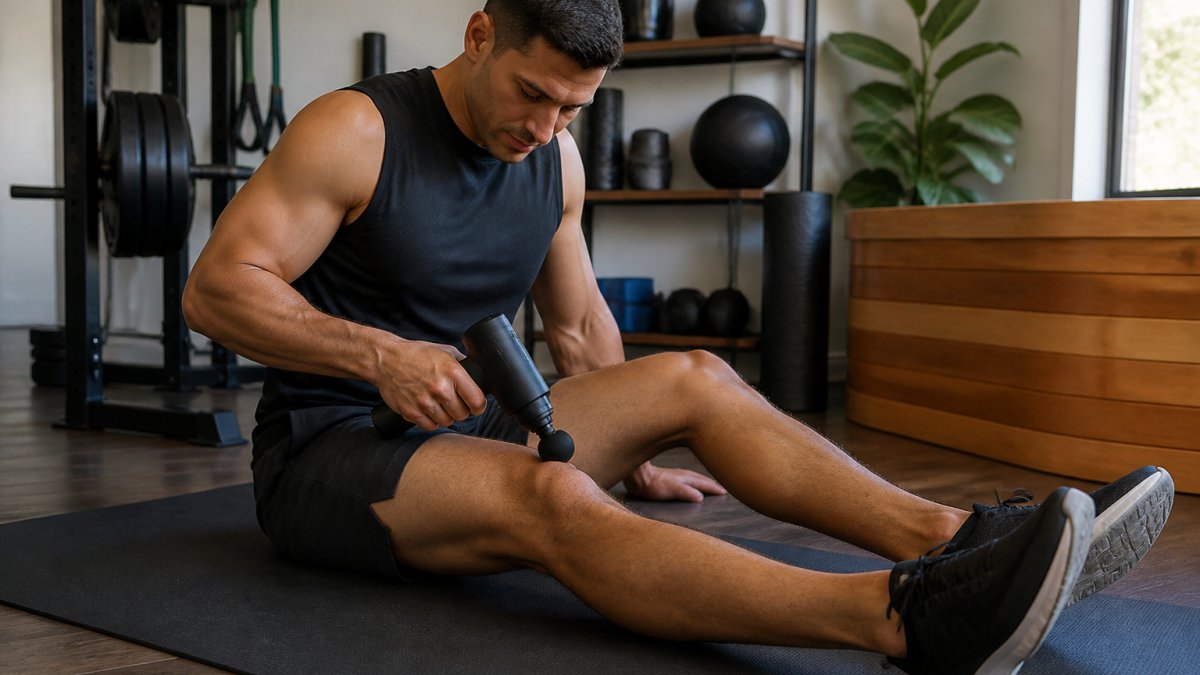
Massage gun (5-10 minutes): Spend 1-2 minutes per major muscle group, targeting areas that worked hardest.
Static stretching (5-10 minutes): Hold each stretch 30-60 seconds, focusing on tight muscles.
Total: 25-40 minutes. This window matters most for athletic recovery.
Evening Relaxation and Sleep Preparation
The evening routine signals your body to wind down for quality sleep.
Heat therapy (15-20 minutes): A warm bath, heat pack, or infrared sauna raises core body temperature; the subsequent drop triggers sleep onset. Most effective 1-2 hours before bed.
Massage chair or massage gun (15-20 minutes): Low-intensity percussion reduces muscle tension and promotes relaxation; use lower settings in the evening.
Stretching and breathwork (5-10 minutes): Slow stretching paired with deep breathing activates your parasympathetic nervous system, where static stretching shines.
Cold Plunge System Designed for Daily Recovery, Iceless Cooling, LLDPE →
Avoid screens (30 minutes before bed): Not equipment-based, but non-negotiable for sleep quality.
Total: 35-50 minutes, directly improving sleep depth and duration.
Sample Weekly Schedule:
- Monday-Friday: Morning (10 min) + Post-workout (30-40 min) + Evening (40 min)
- Saturday: Morning (10 min) + Extended sauna session (45 min) + Evening (40 min)
- Sunday: Gentle morning mobility (10 min) + Light stretching (15 min) + Evening wind-down (30 min)
This schedule is sustainable because it fits real life; adjust to your training intensity and schedule.
Red Light Therapy Panel for Home: Setup and Usage
Red light therapy (wavelengths 600-1000nm) supports cellular energy production and reduces inflammation (pubmed.ncbi.nlm.nih.gov). The science involves mitochondrial function, but the practical outcome matters: faster recovery and less inflammation.
Optimal setup: Position your panel 6-12 inches from your skin, 10-20 minutes daily, starting at lower intensity and progressing as tolerated. The Sport Gains Red Light Therapy Panel uses 72 quad-chip LEDs across four wavelengths (630nm, 660nm, 810nm, 850nm) to target different recovery goals.
Best-use timing: Post-workout (within 30-60 minutes) is optimal; evening sessions support sleep, morning sessions boost energy and mood.
Realistic expectations: Red light therapy works best within a comprehensive routine, not standalone. Combined with cold exposure, stretching, and sleep, effects compound; in isolation, benefits are modest.
Maintenance: Clean monthly with a soft, dry cloth, avoid direct water exposure, and panels typically last 5-10 years.
Cold Plunge at Home: Frequency, Duration, and Safety
Cold water immersion triggers systemic recovery responses: reduced inflammation, improved circulation, and enhanced stress resilience. But it's not for everyone, and frequency matters.
Optimal protocol: Start with 2-3 minutes at 50-60°F, 2-3 times per week.
Safety first: Never plunge alone. Avoid cold exposure with cardiovascular disease, uncontrolled hypertension, or pregnancy. Cold water can trigger dangerous breathing reflexes in untrained individuals.
The Sport Gains Cold Plunge System ($3,089) eliminates ice restocking with iceless cooling.
Frequency reality check: More isn't better. Three sessions per week produces better adaptation than daily plunging. Your nervous system needs recovery time between exposures.
Post-plunge protocol: Exit slowly, avoid immediate intense activity, wrap in a warm towel, and warm up gradually. Never jump straight into a hot shower.
Safety, Contraindications, and When to Stop
Recovery equipment is powerful but not risk-free; knowing when to pause matters as much as knowing how to use it.
Red flags to stop immediately: Sharp pain (not muscle soreness) during any recovery activity. Dizziness or disorientation.
Contraindications for specific tools:
Cold exposure: Avoid with Raynaud's syndrome, severe hypertension, or cardiovascular disease.
Red light therapy: Generally safe, but avoid with photosensitizing medications. With a history of skin cancer, consult your dermatologist first.
Massage guns: Avoid bony prominences, joints, and the spine, never use on acute inflammation or open wounds, and beginners should avoid the neck and head.
Progressive overload in recovery: More isn't always better: the goal is consistency at sustainable intensity. A 10-minute daily routine beats a 60-minute weekly session.
Maintenance, Cleaning, and Equipment Longevity
Your recovery equipment is an investment. Proper maintenance extends lifespan and ensures safety.
Massage guns: Clean the attachment head after each session (most are removable and washable). Charge per manufacturer specs, don't leave on the charger constantly, and store cool.
Cold plunges: Change water every 1-2 weeks depending on usage and clean the tub monthly with mild soap and a soft brush.
Red light panels: Dust monthly with a soft, dry cloth. Never spray liquid directly on the panel. Keep away from moisture and extreme temperatures.
Infrared saunas: Wipe interior benches after each session and ensure proper ventilation to prevent moisture buildup.
Massage chairs: Vacuum the upholstery monthly, wipe the remote, and check mechanical components quarterly for loose bolts or unusual sounds.
Tracking Progress and Knowing Your Routine Is Working
How do you know your recovery routine is working? Subjective feeling matters, but measurable markers give clarity.
Track these metrics:
Sleep quality and duration: use a simple sleep tracker (many phones have built-in apps).
Morning stiffness and range of motion: test weekly (can you touch your toes, and how far?).
Soreness duration after training: rate soreness 1-10 at 24-48 hours post-workout. Consistent recovery should reduce it.
Workout performance: can you train harder or recover faster between sessions?
Subjective energy and mood: rate daily on a 1-10 scale; consistent recovery should improve both.
When to adjust: If metrics plateau after 8 weeks, change something. Rotate which tools you emphasize.
Building a home recovery practice transforms your physical resilience and sleep quality.
Frequently Asked Questions
What equipment do you need to start a home recovery routine?
Start with basics: a foam roller, massage ball, and resistance bands for self-myofascial release and mobility work. These cost under $100 combined and require minimal space. Add a massage gun or percussion massager when you're ready to invest further. Premium options like cold plunges, red light therapy panels, and massage chairs deliver faster results but aren't necessary to begin a home recovery equipment daily use routine. Most people see meaningful improvements with foundational tools used consistently.
How often should you use home recovery equipment for best results?
Daily use is most effective, but consistency matters more than frequency. Foam rolling and stretching work best 5-7 days per week for 10-15 minutes. Massage guns are safe daily but often used 2-4 times weekly. Cold plunges should start at 1-2 sessions per week for 2-3 minutes, never daily without professional guidance. Red light therapy panels can be used daily for 10-20 minutes. Listen to your body; soreness or skin irritation signals you need a rest day. A daily recovery routine at home works best when matched to your actual schedule, not an ideal one.
Is a red light therapy panel for home use actually effective, or is it hype?
Red light therapy shows measurable effects on muscle recovery and circulation when used consistently. The 630nm and 660nm wavelengths (red light) penetrate shallow tissue, while 810nm and 850nm (near-infrared) reach deeper muscle and bone. Results are gradual: expect 4-6 weeks of daily 15-20 minute sessions before noticing reduced soreness or improved sleep. It's not a replacement for movement and sleep, but a genuine supplement. Quality matters; panels with 72 quad-chip LEDs and adjustable wavelengths deliver more reliable results than budget alternatives. Professional-grade panels like the ULTRA360 are designed for consistent daily use without degrading.
Can a cold plunge at home help with chronic inflammation or knee pain?
Cold immersion reduces acute inflammation and can ease delayed-onset muscle soreness, but chronic conditions like knee inflammation require medical evaluation first. Cold water narrows blood vessels, reducing swelling temporarily; it's not a cure. Sessions should start at 2-3 minutes at 50-59°F, 1-2 times weekly. Never plunge if you have cardiovascular issues, Raynaud's syndrome, or active infections. For chronic knee inflammation, combine cold plunging with mobility work, strength training, and professional guidance. A cold plunge at home is one tool in a larger recovery strategy, not a standalone fix.






