


How to Justify Home Recovery Equipment
Table of Contents
- Calculate the Real Cost of Professional Recovery Services
- Cost-Benefit Analysis of Recovery Tools: What Actually Pays Off
- Long-Term Savings of Home Recovery Equipment vs. Ongoing Memberships
- Assess Your Space and Lifestyle Fit
- Best Red Light Therapy Panels for Home: Matching Equipment to Your Goals
- Evidence-Based Recovery Modalities Worth the Investment
- How to Justify Home Recovery Equipment to Yourself (and Your Budget)
- Frequently Asked Questions
Last Updated: September 25, 2026
Calculate the Real Cost of Professional Recovery Services
Most people underestimate their recovery spending. Costs blur across different providers and price points until you add them up.
Professional recovery services cost $50-$300 per session: cryotherapy ($60-$100), massage ($80-$150/hour), infrared sauna ($25-$50/visit or monthly membership), and red light therapy ($40-$75).

Visiting a recovery facility twice weekly costs $200-$600 monthly. Adding monthly massage brings it to $280-$750. Multiple modalities compound the expense significantly.
This is where justifying home recovery equipment starts to make financial sense. You're not just buying a product; you're replacing an ongoing expense with a one-time investment.
Cost-Benefit Analysis of Recovery Tools: What Actually Pays Off
If you spend $300 monthly on professional services ($3,600 annually, $18,000 over five years), home equipment costing $1,500-$5,500 upfront favors home ownership with consistent use.
Most analyses fail by assuming aspirational usage. Be conservative: if you plan five weekly sessions, assume three; if you plan daily use, assume four times weekly. This prevents regret purchases.
A Sport Gains cold plunge ($2,229) breaks even in six months at $400/month cryotherapy spending, then saves $22,000 over five years versus ongoing professional services.

Red light therapy panels pay off fastest due to low operating costs and daily-use potential. A Sport Gains panel ($1,019) drops to under $0.50 per session after two months of daily use, versus $50-$75 per professional session.
The Sport Gains 4D massage chair ($2,720.72) breaks even after 27 sessions at $100/massage, or about six months with weekly use.
Long-Term Savings of Home Recovery Equipment vs. Ongoing Memberships
Home equipment costs stay flat after purchase, while professional memberships typically increase annually from $150 to $170-$180 monthly within three years.
A Sport Gains 3-person FAR infrared sauna ($5,189) costs less than a five-year membership ($4,800-$9,000 at $80-$150/month) and minimal electricity ($10-$20/month).

But the calculation extends beyond pure dollars. Home equipment eliminates travel time. No commute to the facility, no waiting for available time slots, no scheduling around facility hours. If you value time at $50 hourly (a conservative estimate for busy professionals), the time savings alone add thousands to the financial case for home equipment.
Durability matters enormously. Sport Gains equipment is built for daily use with solid cedar construction and professional-grade components specifically designed for longevity. Flimsy equipment that breaks after two years costs more in the long run than investing in durable equipment upfront. The 30-day return policy means you can test whether the equipment fits your lifestyle before committing.
Home equipment also avoids the membership trap. Facilities often require annual contracts or charge cancellation fees. Life changes, you move, work demands increase, your priorities shift. Home equipment remains yours, usable whenever you need it, with no cancellation penalties or wasted months paying for unused access.
Assess Your Space and Lifestyle Fit
Equipment justification fails when the equipment doesn't fit your actual living situation or daily rhythm. A cold plunge requires dedicated space, adequate electrical access, and climate considerations. An infrared sauna needs floor space and ventilation. Red light therapy panels need wall space or a stand. Before calculating ROI, assess whether the equipment actually fits your home.
Start with space. Cold plunges typically measure around 53 inches long by 31.5 inches wide by 25.5 inches high. That's roughly the footprint of a large hot tub. Do you have a backyard, basement, or garage with that available space? Infrared saunas require more, typically 5 feet by 5 feet of floor space. Red light therapy panels can hang on a wall or sit on a stand, making them more flexible.
Climate matters too. Cold plunges work year-round, but cold water in winter means higher heating costs to reach your target temperature. Infrared saunas function in any climate but need proper ventilation to prevent moisture buildup. Consider your local humidity, temperature swings, and whether you have protected outdoor or indoor space.
Cold Plunge Tub Designed for Recovery →
Lifestyle fit determines actual usage. If you travel frequently for work, equipment that requires daily use to justify the investment becomes problematic. A massage chair works for someone who travels half the month, you use it when home, it sits unused when you're away. A cold plunge requires more commitment. Red light therapy panels work for variable schedules since even weekly use provides cumulative benefits.
Household dynamics matter. Does your family share the equipment or is it just for you? Will your partner use the cold plunge? Can family members benefit from the red light therapy panel? Shared usage increases the per-person ROI and justifies higher upfront costs.
Best Red Light Therapy Panels for Home: Matching Equipment to Your Goals
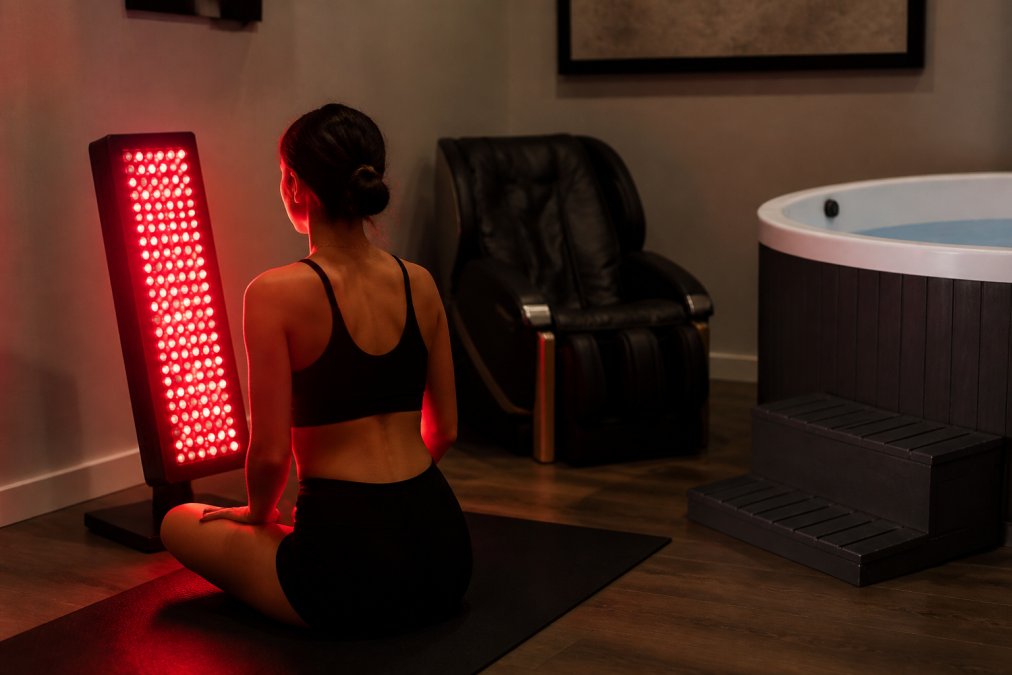
Red light therapy panels deserve specific attention because they offer the fastest ROI and most flexible implementation of any home recovery equipment. Unlike cold plunges or saunas, red light therapy integrates into existing routines with minimal friction.
The Sport Gains red light therapy panel with 72 quad-chip LEDs and multi-wavelength output (630nm, 660nm, 810nm, 850nm) costs $1,019. This wavelength combination supports general wellness use with flexible brightness adjustment and pulse mode settings. The touchscreen control makes daily use simple, no complicated setup or learning curve.
Panel selection depends on your primary goal. General wellness and daily recovery benefit from panels with red and near-infrared wavelengths. Athletic performance and muscle recovery often emphasize near-infrared penetration. Skin health applications sometimes prioritize red wavelengths. The Sport Gains panel covers all applications with its multi-wavelength approach, making it a versatile choice for home use.
Distance and positioning matter practically. Most quality panels work effectively at 6-12 inches from skin. You can mount them on a wall, use a tabletop stand, or position them during your morning routine. The flexibility makes red light therapy one of the easiest equipment additions to justify, it doesn't require dedicated space like a cold plunge or sauna.
Usage frequency compounds benefits. Red light therapy works cumulatively. Daily 10-15 minute sessions provide better results than occasional longer sessions. Home access enables this consistency. Professional facilities charge per session, creating financial friction that discourages daily use. Home ownership removes that friction.
Evidence-Based Recovery Modalities Worth the Investment
Not all recovery methods deserve equal investment. Some have stronger evidence supporting effectiveness; others remain more aspirational. Understanding which modalities have solid backing helps prioritize equipment purchases.
Cold therapy shows consistent evidence supporting inflammation reduction and recovery acceleration. Cryotherapy decreases tissue temperature, which reduces inflammation and slows metabolic processes temporarily, allowing the body to focus repair efforts. This evidence base justifies cold plunge investment for serious athletes or people managing chronic inflammation.
Infrared sauna therapy demonstrates evidence supporting circulation improvement and cardiovascular adaptation. Far-infrared wavelengths penetrate tissue more deeply than traditional sauna heat, promoting blood flow and supporting lymphatic drainage. Regular use shows benefits for cardiovascular health and recovery. The Sport Gains 3-person FAR infrared sauna with carbon panels engineered 40% deeper penetration than ceramic heaters, directly supporting this evidence base.
Red light therapy evidence continues expanding (pubmed.ncbi.nlm.nih.gov). Research supports tissue repair, inflammation reduction, and performance recovery benefits. The multi-wavelength approach of the Sport Gains panel (covering 630nm through 850nm) addresses multiple proposed mechanisms. Daily use builds cumulative benefits, making home access particularly valuable.
Massage therapy and percussive therapy have the strongest evidence base of all recovery modalities. Myofascial release reduces trigger point tension, improves range of motion, and supports recovery. The Sport Gains 4D massage chair with 55-inch SL-track design and 11 professional massage techniques provides consistent, repeatable treatment without requiring professional appointments.
The evidence hierarchy suggests prioritizing equipment that addresses your specific needs.
How to Justify Home Recovery Equipment to Yourself (and Your Budget)
The practical justification comes down to three questions: Can you afford it? Will you use it? Does it solve a real problem?
| Modality | Equipment Cost | Monthly Professional Cost | Break-Even Timeline | Best For |
|---|---|---|---|---|
| Cold Therapy | $2,229 | $300-$400 | 6 months | Athletes, inflammation management |
| Red Light Therapy | $1,019 | $50-$75/session | 3-4 months | Daily wellness, tissue repair |
| Infrared Sauna | $5,189 | $100-$150/month | 36-52 months | Circulation, general wellness |
| Massage Chair | $2,720.72 | $100/session | 6-7 months | Muscle tension, recovery |
Frequently Asked Questions
Can home recovery equipment actually save money compared to professional therapy?
Yes, if you use it consistently. A cold plunge or red light therapy panel pays for itself in 12-24 months if you'd otherwise spend $150-300 monthly on cryotherapy or light therapy sessions. The break-even depends on your current spending and usage frequency. Sporadic users (once monthly) may not recoup the investment; daily or 4+ times weekly users typically see savings within 18 months.
What is the best at-home recovery equipment for daily use?
The best equipment depends on your recovery goals and space. Cold therapy (cold plunges) addresses inflammation and muscle soreness; red light therapy supports circulation and tissue repair; infrared saunas promote relaxation and detoxification; massage chairs target muscle fatigue and trigger points. Start with one modality aligned to your primary need, most users see results with consistent, daily 10-20 minute sessions. Combination setups amplify results but require more space and budget.
How much space do you need for a functional home recovery station?
A minimal setup requires 4×4 feet for a red light therapy panel or massage chair. A cold plunge needs 6×4 feet minimum (for the tub plus access space). An infrared sauna requires a dedicated corner space (roughly 5×5 feet for a 3-person model). If space is tight, prioritize portable equipment (red light panels, massage chairs) over fixed installations. Vertical mounting or foldable options can reduce footprint significantly.
What should I consider before buying home recovery equipment?
Evaluate four factors: (1) Current spending on recovery services, if you spend under $100 monthly, ROI takes longer; (2) Realistic usage frequency, equipment only pays off if used 3-5 times weekly; (3) Available space and durability needs, will the equipment fit and survive daily use?; (4) Your primary recovery goal, muscle soreness, inflammation, flexibility, or stress relief. Misalignment on any factor often leads to unused equipment.


