How to Build a Home Recovery Sanctuary: A Complete Guide
Table of Contents
- Understanding Your Home Recovery Sanctuary
- Choosing the Right Space for Your Recovery Sanctuary
- Best Red Light Therapy Panels for Home Wellness
- Benefits of Cold Plunge Therapy at Home
- Home Wellness Room Design Ideas and Layout
- Building Daily Recovery Rituals and Maintenance
- Accessibility Considerations for Neurodivergent Recovery
- Frequently Asked Questions
Last Updated: October 4, 2026
Understanding Your Home Recovery Sanctuary
A home recovery sanctuary is a dedicated space designed to support physical and mental wellness through intentional environmental design, therapeutic equipment, and daily recovery practices.
Your home recovery sanctuary should reflect your specific recovery goals, whether managing chronic pain, improving sleep quality, or optimizing cellular recovery, rather than following a generic wellness checklist.
According to the American Psychological Association on environmental psychology, physical spaces directly influence stress levels, emotional regulation, and long-term health outcomes.
Choosing the Right Space for Your Recovery Sanctuary
The best space isn't the biggest or most luxurious, it's the one you'll actually visit consistently.
Audit your home for accessibility and traffic flow. A basement sanctuary requires stairs and gets visited less than a bedroom corner.
Temperature stability is critical for recovery equipment. Cold plunges and infrared saunas perform best with consistent temperatures.
Electrical infrastructure deserves attention early. If you're considering equipment like the Cocoon recovery pod, which combines infrared heat, red light, and PEMF technology, you'll need professional-grade electrical support.
Saunas and cold plunges generate humidity. Without proper ventilation, moisture creates mold and structural damage.
Consider your household dynamics too.
Best Red Light Therapy Panels for Home Wellness
Red light therapy panels deliver wavelengths that penetrate tissue and support cellular energy production, circulation, and inflammation management.
Professional-grade panels include multiple wavelengths (630nm, 660nm, 810nm, 850nm) addressing surface and deeper tissue targets.
LED count matters directly. A 72-quad-chip LED panel like the Red Light Therapy Panel with 630nm-850nm wavelengths from Sport Gains delivers consistent output across treatment areas without requiring extended session times.

Touchscreen controls with adjustable brightness and pulse mode let you customize sessions for inflammation management versus circulation optimization. Basic on-off switches limit flexibility.
Solid construction indicates equipment built for daily use.
Placement flexibility matters practically. A panel you can mount on a wall, position on a stand, or hold handheld adapts to different recovery routines.
| Feature | Consumer Panels | Professional-Grade |
|---|---|---|
| Wavelengths | 1-2 options | 4 wavelengths (630nm-850nm) |
| LED Count | 20-40 | 72 quad-chip LEDs |
| Control | On/off switch | Touchscreen with adjustable settings |
| Build Quality | Plastic housing | Durable construction for daily use |
| Warranty | 1 year or less | |
Benefits of Cold Plunge Therapy at Home
Cold water immersion triggers specific physiological responses: reduced inflammation, improved circulation, enhanced parasympathetic nervous system recovery, and improved sleep quality. Cold exposure activates your vagus nerve, shifting your nervous system toward recovery mode.
Cold plunge therapy offers a non-pharmaceutical option for chronic pain and inflammation management.
The at-home advantage is consistency. A portable cold plunge with WiFi app control like the Drift Cold Plunge from Sport Gains reaches 37°F and maintains temperature automatically, removing the friction between deciding to use it and actually using it.

Effective cold therapy operates between 50-59°F for longer sessions or 37-50°F for shorter 1-3 minute plunges.
Portable design changes the equation for people with space constraints or those who travel.
Home Wellness Room Design Ideas and Layout
Effective wellness room design balances multiple functional zones so recovery modalities coexist without competing for resources.
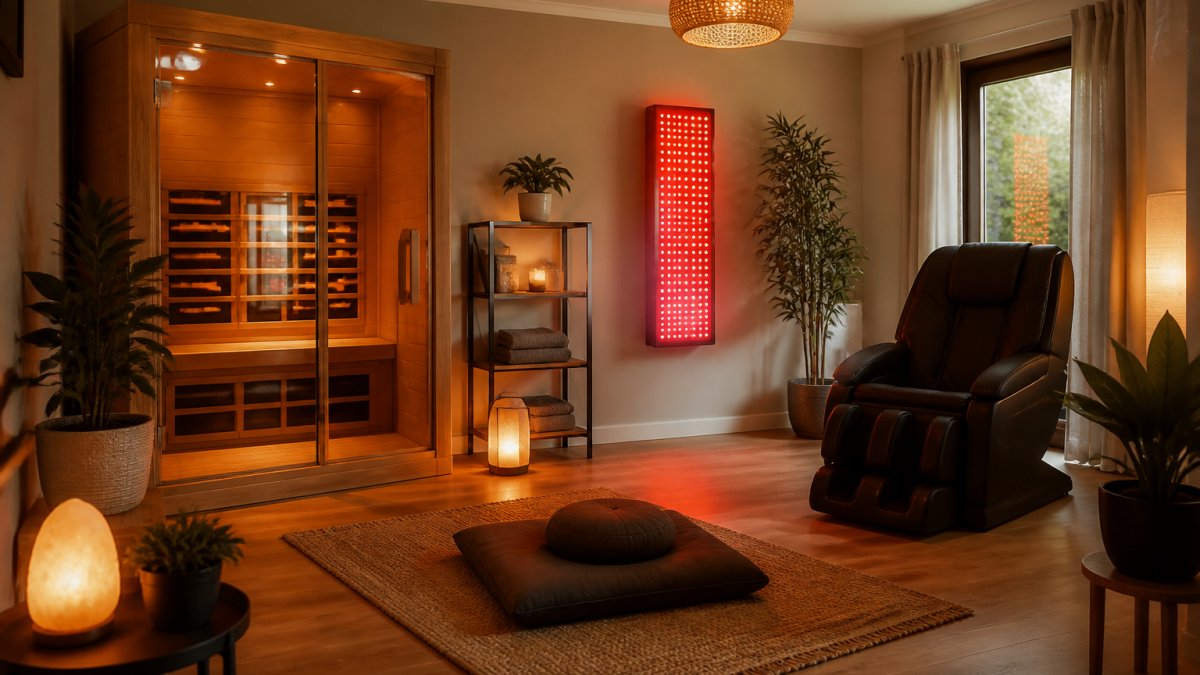
Start with a heat zone if you're including saunas or infrared therapy. These require dedicated electrical circuits and generate humidity, so they work best positioned near existing ventilation. A 3-person infrared sauna like the 3-Person FAR Infrared Sauna in Cedar from Sport Gains occupies roughly 5' x 5' of floor space and works well in corners or against exterior walls where ventilation is easier to manage.

Cold plunges work best positioned away from heat sources. If you're using both saunas and cold plunges, separate them by at least 8-10 feet.
Red light therapy panels mount on walls or stands, so they don't consume floor space.
Massage chairs and relaxation seating should have clear sightlines to windows when possible. Natural light during recovery sessions supports circadian rhythm regulation and mood.
Creating a Dedicated Meditation and Mindfulness Corner
A meditation corner requires minimal space but delivers disproportionate impact on consistency.
A quality meditation cushion supports proper spinal alignment and prevents physical tension that contradicts mental relaxation.
Visual simplicity supports focus. Avoid placing your meditation corner where you can see laundry, work materials, or screens.
Lighting should be dimmable or controlled. Bright overhead lights activate your sympathetic nervous system. Soft, warm lighting (2700K) or candles support parasympathetic activation.
Optimizing Lighting for Mood and Sleep
Light wavelengths directly regulate cortisol, melatonin, and circadian rhythm (pubmed.ncbi.nlm.nih.gov). Wrong lighting undermines everything else you're doing.
Use warm lighting (2700K or lower) during recovery sessions to support melatonin production. Avoid blue light (5000K and above) 2-3 hours before sleep.
Dimmer warm light is more effective than bright warm light for relaxation.
Infrared Sauna Built for Home Wellness, 3-Person Cedar, FAR Carbon Panels →
Smart lighting systems let you adjust color temperature and brightness throughout your session, optimizing nervous system transition into deeper recovery.
Budget-Friendly DIY Sanctuary Hacks
Use existing furniture creatively: comfortable chairs for meditation, shelving to organize tools and create boundaries, mirrors to expand space.
Quality rubber mats or interlocking foam tiles define zones, absorb sound, and protect surfaces from moisture for $100-300.
Low-maintenance plants like pothos, snake plants, and peace lilies improve air quality and create a calming aesthetic.
Storage solutions prevent clutter that undermines the sanctuary feeling.
Building Daily Recovery Rituals and Maintenance
Consistent daily rituals transform equipment from novelty purchases into reliable recovery anchors.
Start with a simple protocol: specific time, sequence, and duration. A routine done daily becomes habitual within 3-4 weeks.
Consistency matters more than intensity. Your nervous system adapts to predictable inputs, making daily rituals more effective than occasional deep sessions.
Track your routine for the first 30 days using a calendar, app, or log to create accountability and notice patterns in what works.
Digital Detox and Technology Management
Your recovery sanctuary loses effectiveness if you're checking your phone during sessions. Digital presence prevents the nervous system downregulation that makes recovery work.
Establish a phone-free protocol: leave your phone in another room or use app blockers during recovery time. Control WiFi-enabled equipment before entering the sanctuary.
One hour daily without digital input improves sleep quality, stress management, and consistency.
Use speakers for ambient sound or guided meditation, not podcasts or music requiring cognitive engagement. Passive audio supports recovery; active listening undermines it.
Long-Term Sustainability and Consistency
The difference between long-term sanctuary users and those who abandon it comes down to removing friction between intention and action.
Make your sanctuary the easiest option. Pre-set equipment, keep meditation cushions in place, and leave cold plunges filled and at temperature.
Seasonal adjustments prevent abandonment. Winter might emphasize sauna and red light therapy; summer might emphasize cold plunge and early morning sessions.
Maintenance schedules prevent equipment failures that derail consistency. Clean your cold plunge filter monthly. Check sauna seals quarterly.
Accessibility Considerations for Neurodivergent Recovery
Sensory sensitivities common in neurodivergent individuals require specific sanctuary design considerations.
Lighting should be adjustable and dimmable. Multiple lighting layers let you control brightness and color temperature completely.
Sound management is critical. Soft furnishings (rugs, curtains, seating) absorb sound.
Equipment with precise temperature control lets neurodivergent individuals dial in their specific preference rather than accepting standard settings.
Natural materials like cedar provide tactile comfort.
Designated zones, labeled storage, and minimal clutter reduce decision fatigue and sensory processing demands.
Building a home recovery sanctuary is fundamentally about creating an environment where wellness becomes automatic rather than aspirational. Whether you start with a single red light therapy panel or invest in a complete setup with sauna, cold plunge, and massage chair, the real work is showing up daily. Your sanctuary only works if you use it. See How It Works and start building the recovery space that actually fits your life.
Frequently Asked Questions
What are the essential elements of a home recovery sanctuary?
A functional home recovery sanctuary combines three core elements: a dedicated physical space free from daily distractions, recovery equipment tailored to your needs (such as cold plunge therapy or red light therapy panels), and a consistent daily ritual that anchors your wellness practice. Start with one primary piece of equipment, like the 3-Person FAR Infrared Sauna, and layer in complementary tools as your sanctuary evolves. The key is creating an environment where your nervous system recognizes recovery is happening.
How do I choose the right space in my home for a recovery sanctuary?
Select a space with minimal foot traffic, adequate ventilation, and room for your primary equipment. A basement, garage, or spare bedroom works well. Consider proximity to water and electricity if using cold plunge therapy or infrared equipment. Ensure the space stays cool enough for heat-based equipment and has temperature stability. Avoid high-traffic areas where family members interrupt your routine. Even a corner of a bedroom can work if you establish clear boundaries about use times.
What are the specific benefits of cold plunge therapy at home?
Cold plunge therapy at home reduces inflammation, enhances circulation, and supports nervous system recovery through controlled cold exposure. Unlike expensive cryo clinics, a home cold plunge like the Drift model reaches 37°F and offers WiFi app control for consistent temperature management. Regular cold therapy sessions improve sleep quality, boost mental clarity, and support physical recovery after workouts. The accessibility of daily use, without travel or scheduling, makes consistency easier, which amplifies long-term wellness benefits.
How much space do I need to build a functional recovery area?
A basic recovery sanctuary requires 100-150 square feet for core equipment and movement space. The 3-Person FAR Infrared Sauna measures 5' x 5', leaving room for a massage chair, red light therapy panel, and meditation corner in most basements or spare rooms. If space is limited, prioritize vertical storage for smaller tools and consider portable equipment like the Drift Cold Plunge, which folds for storage. Even 80 square feet works if you focus on one primary piece and rotate secondary tools.
How do best red light therapy panels for home compare to professional clinic treatments?
Professional-grade red light therapy panels like the ULTRA360 with 72 quad-chip LEDs and multi-wavelength output (630nm, 660nm, 810nm, 850nm) deliver clinical-level results at home. The key difference is consistency: daily 10-15 minute sessions at home often outperform monthly clinic visits because you build sustainable habits. Home panels eliminate travel time and scheduling friction, making it realistic to use therapy 5-6 days weekly. Touchscreen controls let you adjust intensity and wavelengths for your specific recovery needs.
What is the best way to organize recovery equipment for daily use?
Organize equipment by use frequency and session time. Place your most-used tool, whether a cold plunge or sauna, in the most accessible spot. Store smaller items like red light panels on adjustable shelving for easy access. Create a visual checklist near your sanctuary entrance showing your daily ritual sequence. Keep maintenance supplies (cleaning solutions, replacement filters) in a labeled cabinet nearby. This removes decision friction and makes daily use automatic rather than requiring motivation each time.
Can I use home recovery equipment if I travel frequently for work?
Home recovery equipment works best with consistent use, but portable options like the Drift Cold Plunge (80-gallon capacity, 134-pound cooling unit) travel with you if needed. If you travel half the month, focus on one durable, stationary piece like an infrared sauna as your anchor, and use portable tools during travel weeks. Alternatively, establish a 3-4 week commitment window when you're home to build the habit, then maintain consistency around your travel schedule. Many busy executives find that even 2-3 sanctuary sessions weekly during travel months sustains progress.
Does the 30-day return policy cover setup issues or buyer's remorse?
Sport Gains' 30-day return policy protects your purchase if equipment doesn't meet your expectations or doesn't integrate well into your space. This covers setup concerns, fit issues, or genuine dissatisfaction. The policy removes financial risk when investing in premium equipment like the Cold Plunge Tub or Infrared Sauna. If you set up the equipment and realize daily use isn't realistic for your lifestyle, you have a clear 30-day window to return it without penalty. This makes it realistic to test equipment commitment before long-term investment.