


How to Read Red Light Therapy Results After 1 Month
Last Updated: November 1, 2026
Quick Summary
Red light therapy results after 1 month of use are usually felt before they are seen: many users report smoother, more hydrated skin within the first 30 days even when mirror changes are not yet visible. Visible improvements in skin tone, texture, and elasticity typically begin after 3-4 weeks of consistent use.
- Use three to four sessions per week, 10-12 minutes each, to give month one a fair test.
- Keep the panel at a constant 6-12 inches; moving closer is the most common month-one mistake.
- Track two metrics, not five, since more data points just create noise.
- If you miss a full week, restart at week-one duration for three sessions before returning to your cadence.
- Pause if you experience irritation, unusual sensitivity, or are using photosensitizing medication.
Table of Contents
- What Red Light Therapy Results After 1 Month Actually Look Like
- The Red Light Therapy Timeline for Skin: Week by Week
- How Often Should You Use Red Light Therapy Panels to Hit the 1-Month Mark?
- Red Light Therapy Benefits for Muscle Recovery in the First 30 Days
- Why Your Panel's Power Density Matters More Than Session Length
- How to Track Progress: Metrics That Show Up Before the Mirror Does
- The Plateau Effect and Who Should Pause at 30 Days
- Building Your 30-Day Red Light Routine With Sport Gains
- Frequently Asked Questions
What Red Light Therapy Results After 1 Month Actually Look Like
Red light therapy results after 1 month of use are rarely dramatic in photographs, and that surprises people. According to clinical trial reviews compiled by PMC, most trials showing measurable collagen improvements used sessions of 10-12 minutes a day, twice per week, and those changes built gradually rather than overnight.
Here is the honest answer. One month is enough to feel a difference and barely enough to see one.
The research backs that split. A controlled trial indexed on PubMed found subjects experienced significantly improved skin complexion, skin feeling, and reduced skin roughness measured by profilometry and ultrasound, but those measurements came from structured protocols, not casual mirror checks. Meanwhile, the American Academy of Dermatology's public guidance notes that more than 90% of patients in reviewed settings reported softer, smoother skin, reduced redness, and lightening of dark spots, with the emphasis on reported.
Below, we break down what month one realistically delivers, how to tell whether your panel is working, and when to change course.
The Felt-vs-Seen Gap in Month One
The felt-versus-seen gap is the difference between physical sensations of improvement and visible changes in the mirror, and in month one the felt side almost always wins. Many users report skin feeling smoother and more hydrated within the first 30 days even when visual changes are not yet apparent, according to LED Esthetics usage guidance.
That gap trips people up. They expect a before-and-after photo and get a texture they can only detect with their fingertips.
The Red Light Therapy Timeline for Skin: Week by Week
The red light therapy timeline for skin follows a predictable arc, and knowing it prevents the panic that hits around day 18. Photobiomodulation is the process by which red and near-infrared light interacts with cells to support energy production and tissue response, and that process runs on biological time, not willpower.
Weeks 1-2: The Quiet Phase
Nothing visible happens. This is normal, and it is where most devices get abandoned.
What is occurring underneath is mitochondrial support for ATP production and cellular energy, the mechanism that eventually shows up as better texture. Expect nothing from the mirror in week one.
Weeks 3-4: Texture and Tone Start to Shift
Visible improvements in skin tone, texture, and elasticity typically begin after 3-4 weeks of consistent use, per Brillare Beauty Institute frequency guidelines. That is the window where the felt-vs-seen gap starts closing.
Fine lines will not vanish at week four. Skin elasticity and complexion may read slightly better in daylight.
How Often Should You Use Red Light Therapy Panels to Hit the 1-Month Mark?
The short answer: three to four sessions per week, 10-12 minutes each, is the frequency most likely to produce measurable change by week four. Measurable skin rejuvenation results are most commonly observed after 8 to 12 weeks at 3 to 4 sessions per week, according to Ottawa Rhinoplasty's clinical timeline guidance, which means month one is the foundation, not the finish line.
But frequency without dose math is just a schedule. What actually determines whether month one produces anything is the total energy delivered to the skin, and that is a product of irradiance (mW/cm²), session time, and how close the panel sits to your body.
The Dose Math Most Guides Skip
Photobiomodulation has a therapeutic window. Too little energy and nothing happens; too much and you can blunt the response through a biphasic dose-response curve.
That is why two panels advertising identical 660nm and 850nm wavelengths can produce very different one-month outcomes. The wavelength is the key; the irradiance is how hard you turn it. If your device does not publish irradiance at a stated distance, assume the real number is lower than the marketing number and extend session time accordingly rather than guessing.
A Week-by-Week Frequency Schedule for Month One
| Week | Sessions | Duration | Placement | What to Watch |
|---|---|---|---|---|
| 1 | 3 | 8-10 min | 6-12 in from target | Skin tolerance, no flushing that lasts past 1 hour |
| 2 | 3-4 | 10 min | Same distance | Hydration feel, sleep score |
| 3 | 4 | 10-12 min | Same distance | Texture on cheeks and forearms |
| 4 | 4 | 10-12 min | Same distance | Soreness recovery, tone in daylight |
Keep the distance constant. Moving closer to "speed things up" is the most common month-one mistake because it pushes surface irradiance past the useful range without adding benefit.
What to Do When You Miss Sessions
Consistency beats intensity here. Missed weeks cannot be recovered with a marathon session, stacking two sessions back-to-back does not double the dose response, and it raises the risk of irritation. If you miss two sessions in a week, resume the normal schedule the following week rather than adding catch-up sessions. If you miss a full week, restart at week-one duration for three sessions before returning to your previous cadence.
Skin vs. Muscle: Different Cadences
Skin remodeling responds best to the 3-4x weekly cadence above because collagen synthesis runs on a slower cycle. If you are chasing both outcomes in month one, prioritize one goal for the first 30 days so your tracking data stays clean.
If you want a panel built for that daily cadence, our red light therapy panel designed for daily wellness runs four wavelengths across 72 quad-chip LEDs with touchscreen control at $1,019.00.
Red Light Therapy Panel Designed for Daily Wellness, 4 Wavelengths, 72 →

Red Light Therapy Benefits for Muscle Recovery in the First 30 Days
Muscle recovery is where month one often delivers more noticeable returns than skin.
The evidence is not uniform. Stanford Medicine's 2025 review notes studies on red light therapy have shown inconsistent success, though specific applications in wound healing showed complete healing at six weeks. Read that carefully: inconsistent overall, promising in targeted use.
For a joint-specific protocol, our guide on red light therapy for knee pain walks through placement and session timing.
Why Your Panel's Power Density Matters More Than Session Length
Irradiance, the power delivered per unit area, determines whether a 10-minute session actually reaches the therapeutic window. A weak panel forces long sessions that still underdeliver. A stronger one reaches the dermal layer in less time.
This is the specification most buyer guides skip. Two panels can advertise identical wavelengths and wildly different output.
Our full body panel with 300 quad-chip LEDs delivers 630nm, 660nm, 810nm, and 850nm output with adjustable brightness and pulse mode at $1,739.00. For a broader comparison of specifications before you commit, the best red light therapy panels buyer's guide breaks down what separates professional-grade hardware from the rest.

How to Track Progress: Metrics That Show Up Before the Mirror Does
| Metric | How to Measure | What Month One Shows |
|---|---|---|
| Skin hydration feel | Morning fingertip check, same time daily | Often improves by week 3 |
| Redness after cleansing | Standard lighting photo, same angle | Subtle reduction |
| Soreness recovery | Rate 1-10, 24 hours post-workout | Noticeable in weeks 2-4 |
| Sleep quality | Simple nightly 1-5 score | Variable, often improved |
| Skin texture | Gentle cheek sweep, no product | Smoother by week 4 |
Track two metrics, not five. More data points just create noise.
The Plateau Effect and Who Should Pause at 30 Days
Some users hit a plateau around week four and assume the device failed. Results often build over a longer period than four weeks. But "keep going" is not useful advice if the real problem is that your setup never delivered a therapeutic dose in the first place. This is the section most guides skip: how to tell the difference between a normal plateau and a protocol that was never working.
Troubleshooting 'No Results' at 30 Days
Work through these in order before you conclude the device does not work for you:
- Wrong wavelength for the goal. 630-660nm red light penetrates shallowly and suits surface texture, tone, and wound healing. 810-850nm near-infrared reaches deeper tissue and is the range associated with muscle recovery and joint comfort. A red-only panel used for soreness will underdeliver no matter how long you sit in front of it.
- Distance too far. Irradiance falls off with the square of distance. A panel rated at 100 mW/cm² at 6 inches may deliver a quarter of that at 12 inches. If you have been sitting across the room, move to the published distance.
- Session too short for the device's output. A low-irradiance panel at 10 minutes may never reach the 4-10 J/cm² range. Extend to 15-20 minutes or upgrade hardware.
- Skin type and baseline. Baseline matters more than device brand.
- Inconsistent use. Fewer than two sessions per week for four weeks is not a fair test of the technology.
- Photosensitizing medications. Certain antibiotics, retinoids, and herbal supplements increase light sensitivity and can produce irritation that masks progress. Check with a physician before continuing.
If you have addressed all six and still see nothing at day 30, the honest answer is that month one was not a fair trial, give it through week eight before changing course.
Who Should Actually Pause
Pause if you experience irritation, unusual sensitivity, or you are using photosensitizing medication. Anyone with a photosensitive condition, including a history of light-triggered reactions, lupus, or porphyria, should clear red light exposure with a physician first. Pregnant users should consult a clinician before starting a new protocol. For everyone else, the plateau is a signal to keep going, not to stop.
The Post-3-Month Plateau Nobody Warns You About
Month one is not the plateau most people should worry about. The one that catches users off guard arrives around months three to four, after the initial gains have stabilized. Results from photobiomodulation have been shown to last for up to 1 month after stopping device use, per a 2023 PubMed study on structural skin rejuvenation, which is why a maintenance cadence beats an on-off cycle.
Building Your 30-Day Red Light Routine With Sport Gains
A workable month-one routine looks like this: three to four sessions per week, 10-12 minutes per session, panel positioned 6-12 inches from the target area, same time of day so it becomes automatic. Log two metrics weekly. Take one photo at day zero and one at day thirty, same lighting, same angle.
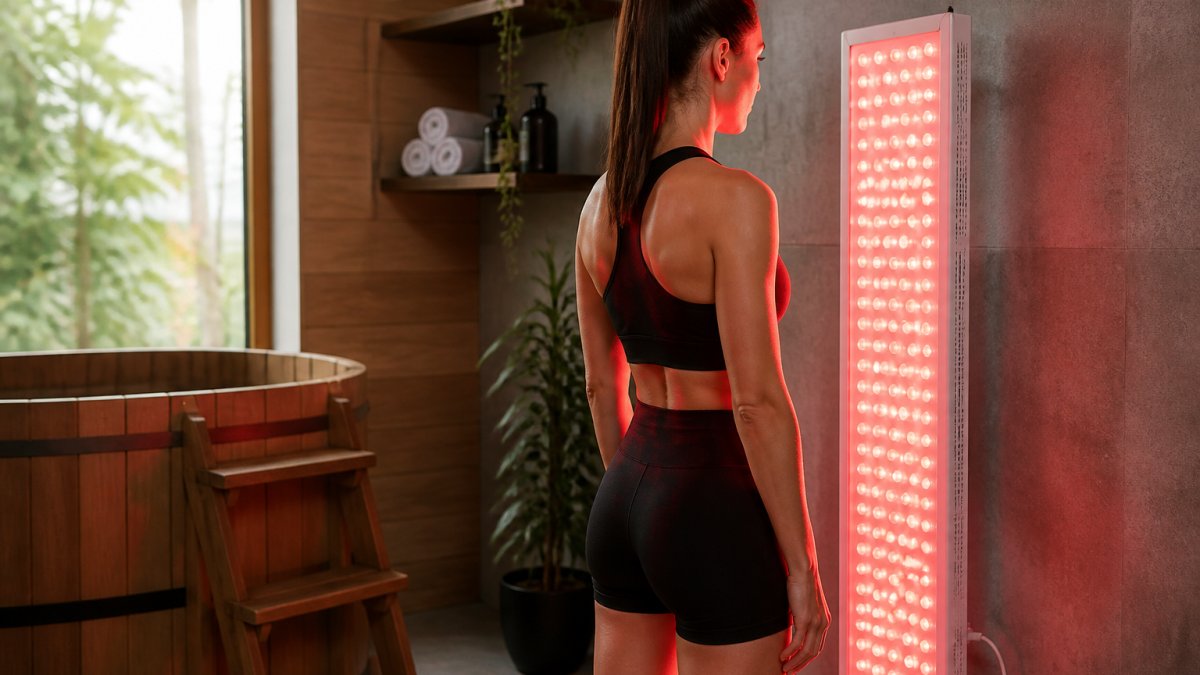
Results from photobiomodulation have been shown to last for up to 1 month after stopping device use, per a 2023 PubMed study on structural skin rejuvenation, which is exactly why consistency matters more than any single session.
If you are still weighing home equipment against spa appointments, our breakdown of red light therapy versus spa sessions covers cost, efficacy, and setup side by side.
Frequently Asked Questions
How long before red light therapy shows visible skin improvements?
Visible changes in skin tone, texture, and elasticity usually start appearing after 3 to 4 weeks of consistent use, Results vary by individual and consistency of use.
What physical changes can I expect after 30 days of red light therapy?
At the one-month mark, most people report skin that feels smoother and more hydrated, along with reduced redness and lightening of dark spots.
How often should you use red light therapy panels to see results in a month?
Consistency matters more than session length, so a shorter session you actually complete beats a long one you skip.
Does red light therapy work faster with high-intensity panels?
Higher power density can shorten the time needed per session, but it does not bypass the body's biological timeline for collagen synthesis and cellular rejuvenation.
The hardest part of month one is trusting a process you cannot see yet. We built Sport Gains around that problem: professionally sourced panels with the power density to make short sessions count, durable construction for daily use, and a 30-day return policy so you can test the routine without risk. Get started with Sport Gains and give your first month a fair shot.


